We hope this update finds you well.
Here is the latest comprehensive update on the ASE Lois LP (10 well portfolio), covering the operational progress achieved during January and early February 2026, including some details on our development plans.
January 2026 Production Results:
The Lois Anne #1-1 well has stabilized at 5-7 barrels of oil per day following a small acid treatment completed in December 2025. The treatment consisted of 1,200 gallons of 15% NeFe (Iron Control acid) flushed with 2% KCL, which was pressured up and dumped down the annulus to treat the perforations after possible buildup of drilling debris. Following the acid job, the pump was swabbed to a rebuilt 1-1/4" rod pump for improved efficiency.
The well is now running off casinghead gas, and we are observing increasing gas volumes following the acidization work.
Important Gas Production Development:
While the acid treatment did not significantly increase oil production, it appears to have positively impacted gas production. The gas volume appears to be increasing, and Bates Instrumentation will be servicing the gathering system in February to check volumes and calibrate the meters.
We are currently awaiting sales meter volumes from Enerfin (our gas purchaser) for January to confirm the actual gas volume allocation for Lois Anne #1-1.
Preliminary indications suggest gas production may be significantly higher than initially measured, which would substantially improve well economics and monthly revenue.
Once our saltwater disposal well (SWD) is operational, we will have the capability to reopen the 1st Wilcox formation in this well. This will enable commingled production from two formations simultaneously, with the potential to open additional productive zones to substantially increase both oil and gas production. The SWD's 10,000 barrels per day disposal capacity will handle the increased water volumes associated with multi-zone production, making this enhanced completion strategy both technically and economically viable.
Due to the severe freezing temperatures experienced across Oklahoma in late January, completion operations on the Lois Anne #2-1 well were temporarily delayed. These extreme weather conditions impacted field operations across the region, requiring us to postpone operations until safe working conditions returned.
On February 4th, St. Louis Completion Services commenced open-hole completion operations targeting the Viola formation.
The completion procedure involved:
Wireline logs and geological analysis have confirmed that a fault was encountered between the Lois Anne #1-1 and #2-1 wells. The #2-1 well came in roughly 10-12 feet structurally higher than the #1-1 well, indicating fault displacement across this portion of the field.
This fault discovery is significant for understanding:
Wireline logs and formation samples from Lois Anne #2-1 show:
Booch Formation: Potentially productive zones identified
Calvin Formation: Shows of hydrocarbon productivity
Hunton Formation: Confirmed presence
Viola Formation: Target zone for open-hole completion
On February 5th, ASE co-founders Dylan Knight and Chris Hemsworth were on location to observe the operations firsthand. During this two-day operational period, with geologist John Dowds, drilling supervisor Matt Burns from OGP, and field operations manager Toby on-site, we observed a 20-30% oil cut during testing - a strong indicator of hydrocarbon productivity from the Viola formation.
The well is being evaluated for production performance from the Viola formation. Based on results from this initial completion, we will determine:
The fault identification between #1-1 and #2-1 will be factored into all future completion design decisions, particularly regarding hydraulic fracturing treatments that could be influenced by fault plane orientation.
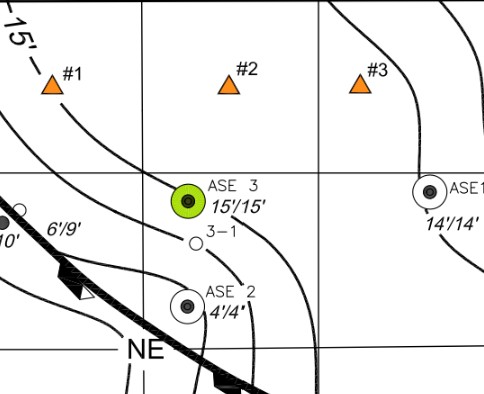
Wireline logs confirm the potential for fault separation between the #3-1 wellbore and the #2-1 wellbore to the west. This discovery suggests yet another small fault across the N/2 NE/4 section of the field.
Significance: We now have evidence of multiple fault structures crossing the ASE Lois LP acreage. Understanding this fault network is critical for:
Initial wireline log analysis by geologist John Dowds shows productive potential in multiple formations:
1st Wilcox Formation: Shows potential for hydrocarbon production - proposed as primary completion target
Viola Formation: Demonstrates productive characteristics
Booch Formation: Interestingly, the Booch in the #3-1 well appears to be separate from the Oddfellows ASE-3 Booch to the north, suggesting fault-related reservoir compartmentalization. This finding will influence our Booch development strategy and spacing considerations for future Booch-targeted wells.
Hunton Formation: Logs and samples show a productive zone, confirmed by the open Hunton perforations currently producing in the Oddfellows ASE-2 well to the south. This provides confidence in the Hunton's high production potential at the Lois Anne #3-1 location.
Geologist John Dowds is completing detailed geological mapping, log analysis, and cross-sectional work integrating all three Lois Anne wells (#1-1, #2-1, #3-1). This comprehensive subsurface analysis will provide:
We have made the strategic decision to pause completion operations on the #3-1 well until:
With the SWD in place and comprehensive geological understanding, we will be able to implement a multi-zone commingled completion strategy targeting the 1st Wilcox, Calvin, Hunton, Booch, Woodford, Ada Sands and the 1150 Stray and potentially other productive intervals. This approach will:
Current Status: Temporarily shut-in, awaiting SWD operational status
Strategic Plan: Once the saltwater disposal well is operational, the ASE-1 well will be brought into production and commingled with potentially up to 3 of the perforated formations to maximise production output.
Conservative Production Forecast: Based on historical test data and Hunton performance in offset wells, we conservatively estimate ASE-1 will produce:
This well represents significant near-term production addition (within 2-3 months) once the SWD is commissioned.
January 2026 Production Results:
Operational Status: The ASE-2 well continues to run smoothly with very few operational issues throughout January. Production has stabilized at consistent rates, and the well requires minimal maintenance.
The Carter Reynolds well maintained steady production throughout most of January, hovering around 2.25 barrels of oil per day. Operations have been running smoothly with minimal maintenance requirements.
The well was shut-in from January 24-27 due to severe freezing temperatures and adverse weather conditions that impacted field operations across Oklahoma. This 3-day shutdown was necessary to protect equipment and ensure safe working conditions during the extreme cold weather event.
Based on comprehensive analysis of drilling data from our recent wells and the exceptional performance of the ASE-3 well (our most successful well, producing exclusively from the Booch formation), we have made a strategic decision to prioritize drilling a dedicated Booch formation well as our next development target.
Geologist John Dowds has identified new drilling locations north of the ASE-3 well, and he is confident that these locations represent the best Booch formation drilling opportunities we have identified to date. This assessment is based on:
The new drilling locations require an increased density spacing application to be submitted to the Oklahoma Corporation Commission. We are working to expedite this process and secure a special hearing, which would allow us to potentially obtain drilling permits within 2-4 weeks, with drilling operations to commence shortly thereafter.
We will provide updates on the permitting timeline as we progress through the regulatory process.
As most investors will be aware, the ASE-3 well has been the most successful well on location, exclusively producing oil and gas from the single Booch formation zone. In our conversations with John Dowds this week, he expressed strong confidence that the locations he has selected will produce the best Booch wells we have drilled to date.
The Lois Anne #4-1 well represents a high-confidence drilling target based on proven formation performance and optimal geological positioning. The exact location has been selected and is shown as the orange triangle numbered "2" on the map attached to this update.
Following the Lois Anne #4-1 well, we will proceed with drilling the Lois Anne #5-1 and #6-1 wells to complete the 10-well portfolio. Formation targets for these wells will be determined based on integrated geological analysis and the performance data gathered from our current producing wells.
As covered in previous portal updates, the saltwater disposal well (SWD) conversion is the critical infrastructure investment that will unlock the full production potential of the ASE Lois LP development. This facility will enable us to pursue aggressive multi-zone commingled completions that would otherwise be uneconomic due to water handling constraints.
Key Capabilities:
Anticipated Approval: Based on typical UIC permit processing timelines and the completeness of our application, we anticipate permit approval within the next 3-5 weeks.
Post-Approval Operations: Once the permit is granted, conversion operations (perforation, testing, and commissioning) will commence within 2-3 weeks, bringing the SWD online approximately 5-8 weeks from today. Please note that we are proactively working to expedite the process, and the timeline may be shorter than the estimates provided.
The SWD approval and commissioning will immediately unlock:
This infrastructure investment represents a field-wide production multiplier, enabling us to access reserves that are currently trapped behind water disposal economics.
Significant progress has been made on infrastructure development across the ASE Lois LP oilfield:
Power Line Installation:
Site Preparation:
Tank Battery & Facilities:
As our investor partners are aware, the ASE Lois LP drilling program has encountered multiple productive formations that were not originally anticipated in the pre-drill geological model. These discoveries - including the Calvin formation, enhanced Hunton intervals, and expanded Booch potential - represent significant upside to the project, plus other payzones (up to 7 in total).
This wealth of geological data requires careful evaluation and strategic completion planning. Our approach prioritizes:
We recognize that drilling and production timelines have been longer than originally estimated. However, the substantial oil and gas resource base we have discovered justifies the careful, methodical approach we are taking under the guidance of geologist John Dowds and our engineering team.
Immediate Priorities:
Near-Term Operations (Next 30-90 Days):
Strategic Outlook:
The convergence of proven formation targets (Booch), essential infrastructure (SWD), and comprehensive geological understanding positions the ASE Lois LP for significant production growth as we execute the remaining drilling and completion operations in 2026.
The ASE Lois LP development program continues to advance with strategic decision-making based on geological data, operational learnings, and proven formation performance. The pivot to prioritize Booch formation drilling reflects our commitment to deploying capital in the highest-confidence, highest-return opportunities identified through our drilling program.
We appreciate your continued confidence and patience as we methodically develop this substantial oil and gas asset. The Lois Anne #4-1 well, targeting the proven Booch formation with the best geological characteristics we have identified, represents a high-confidence next step in unlocking the full value of this 10-well portfolio.
We will provide the next portal update once more information is available and when each milestone has been achieved.
Best regards,